Eligible for COVID Vaccination (HP211)
Purpose:
This protocol will:
- alert the clinician via the alert box if the patient is within the criteria for the Spring 2026 COVID programme
- only display during the current COVID vaccination campaign
What does it actually do?
The protocol performs the following functions:
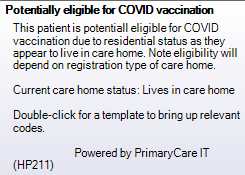
- provides a helpful alert to the user if the patient they have loaded is eligible for a COVID vaccination.
- Patients aged 75 or over (or due to turn 75 by 30/6/26)
- Patients with codes indicating immunosuppression
- Patients with codes indicating residential status of care or residential home
- users can double-click the alert text for a template to record if they have administered or declined the alert.
- the alert will not appear if the patient has declined a COVID vaccination within the last 3 months, or had a COVID vaccination within the last 3 months.
- if the patient is contraindicated, or has declined a COVID vaccination but more than 3 months ago, and alert will appear saying the patient is eligible but contraindicated/declined previously.
- Streamline and encourage the use of appropriate codes.
- The alert will be updated with any changes to the COVID vaccination programme
What does it look like?
All images contain test patients. No real data is used.
Supporting CQC key areas
Safe
Medicines management
- S1 Are there reliable systems, processes and practices to keep people safe and safeguarded from abuse?
- S3 Are there reliable systems, processes and practices to ensure proper and safe handling of medicines?
- S4 Do staff have all the information they need to deliver safe care and treatment to people who use services?
Effective
- E1 Are people’s needs assessed and care and treatment delivered in line with current legislation, standards and evidence-based guidance to achieve effective outcomes?
- E2 How are people's care and treatment outcomes monitored and how do they compare with other similar services?
- E3 Do all staff have the skills, knowledge and experience to deliver effective care and treatment?
- E5 How are people supported to live healthier lives and how does the service improve the health of its population?
Caring
- C1 Are people treated with kindness, respect, and compassion and given emotional support?
- C2 How does the service support people to express their views and be actively involved in making decisions about their care, treatment and support?
- C3 How is people's privacy and dignity respected and promoted?
Responsive
- R1 Are services delivered to meet people’s needs?
- R2 Do services take account of the needs of different people, including those in vulnerable circumstances?
- R3 Can people access care and treatment in a timely way?
- R4 How are people’s concerns and complaints listened and responded to and used to improve the quality of care?
Well-led
- W2 Is there a clear vision and credible strategy to deliver high-quality sustainable care to people who use services, and robust plans to deliver?
- W3 Is there a culture of high-quality, sustainable care?
- W5 Are there clear and effective processes for managing risks, issues and performance?
- W6 Is robust and appropriate information being effectively processed and challenged?
System Dependencies:
The alert relies on good use of the clinical system to code contraindications, declining vaccinations, immunocompromised patients and timely recall as needed.
System Trigger
System Trigger: Load a patient record
Run mode: Always run
Enable trigger for: All clinical prescribers
How to get it
Optional Handy Protocols will need to be 'activated' within your clinical system. See our support article for instructions: How to locate Optional Handy Protocols and Activate these
Support Information
Development Log
Version 2.0.0
Published 10th April 2026